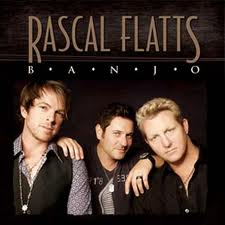
According to Rascal Flatts bass guitarist Jay DeMarcus, the banjo has become an elusive, endangered species.
(So is a Rascal Flatts rocker that doesn’t want to make you jam with anyone named Elroy, throw away your old Igloo cooler and lose your appetite every time you see a Sonic Drive-In.)
To put the lead single from the formidable trio’s forthcoming eighth studio album in perspective, a brief backstory of the instrument in the spotlight is warranted.
Indeed, the banjo has been long revered as a quintessential ingredient in not only country music, but as an integral part of all American music. Brought to the United States via the slave trade (the earliest documented mentioning of a “banshaw” is generally believed to be 1678, from an autobiographal note in Martinique that describes a convergence of slaves prior to deportation in which one is depicted plucking a “banza”.) Thomas Jefferson, himself, would later recognize this instrument in 1781, who referred to it as a “banjar.”
From the formation of the Sweeney Mistrels to their integration into parlors in mid-nineteenth century Boston, from the emergence of celebrated banjo legends such as Charlie Poole and Earl Scruggs during the mid-twentieth century to helping differentiate American country music from Western European influences then onward……..the banjo, in all its clawhammered, fast-arpeggiated glory, has stood the tests of time and its legacy is secure.
Tragically, recent years have not been kind to this tone-ringed, sometimes fretless, watermark. Since its heyday, it has been relegated from the forefront of traditional American music to something treated like “natural flavor” to add a hint of distinctive zest to modern country radio tracks. You’d be hard-pressed, in fact, to find something on your local radio station’s playlist that prominently features a banjo as opposed to merely being submerged in the mix.
*
But no need to fear, y’all! Rascal Flatts are back to rescue this five-stringed wonder from obscurity………..I guess.
According to an interview by DeMarcus on the eve of this single’s release, he explained that “Banjo” is about “getting away from the hustle and bustle of everyday life” by driving as far out into the backwoods as you can “until you go so far you start to hear a banjo.”
In theory, that makes for an enticing, musical journey. So why is it that “Banjo” is at its most intimate in the opening minute, and ends at its most obstreperous?
The first two verses bow with a notably banjo (!) driven arrangement, free of schmaltzy string arrangements and Huff’s signature 80′s-rawk sensibilities. Lead vocalist LeVox laments how the “B.S.” has gotten so thick in the concrete jungle that he has decided to rev up his four-wheel drive and make a run for the back roads. By the time the chorus kicks in, the trio suddenly regresses to a standard arena-rock chorus that sounds as though it was cloned from “Summer Nights”, with LeVox beseeching you must “kick it into four-wheel drive when you run out of road, and you go……..until you hear banjo.”
“Banjo” steadily ramps it up from there, where LeVox goes on to brag in the third verse that their “little place of heaven hidden” has not been tracked by the satellites or G.P.S. yet (I’m willing to bet the song’s three co-writers we can eventually track it on Google Maps.) Finally, by the time we reach the song’s coda, rather than being greeted with an intimate, back-patio banjo solo or perhaps a whiff of mountain music, the group finally regresses to its stereotypical stadium-rock histrionics, with the touch-ups of banjo deafended by high octane blasts of electric guitar testosterone as the group fist-pumps to battle cries of “Whoa oh oh!”.
If “Banjo” is any sort of musical statement, it is quite a contradictory one. By DeMarcus’s logic……….shouldn’t the song start off dominated by electric guitar, only to gradually veer closer to traditional instruments and sounds as it goes on? It certainly sounds to me like, the more closer the group drives home to the hinterland, the more noise and distraction there tends to be! Perhaps the B.S. is even thicker where the G.P.S. don’t sleep!
Then again, considering the arrangement, suppose we were to re-think “Banjo”. Perhaps, “Banjo”, if anything, is an existential crisis put to music. It concerns a troubled protagonist, who “can’t take a breath without gettin’ sick” in this wasteland of the 21st century, and is idealistically driven to try and find a relic that has been long believed to have faded into obscurity. The longer and longer he drives on, the more desperate he grows, yet his panglossian disposition encourages him to press on. Finally, by the coda, he has started to become unhinged by his migraine-induced desperation that he, emotionally, has “ran out of road” as he hears what sounds like the last banjo crying insolably as it is being usurped and broken apart by stratocasting poachers.
Whatever this single’s three writers were intending, it misfires as a musical statement of sorts. In spite of this, that contradiction doesn’t necessarily defeat the entire listening experience. I for one appreciate the renewed energy output here, especially following back-to-back ballads (and several album cycles dominated by schmaltzy ballads before that). Also noteworthy is the fact LeVox’s vocal performance here is not nearly as overdone as we have been accustomed to hearing of him overall. LeVox actually sounds like he’s enjoying the ride here, rather than belting as though it’s all life or death. He even sounds rapturously laid-back often, most notably during the verses.
If anything, the group would benefit from channeling this sort of renewed hunger a little more often (minus the last 35 seconds)……………..albeit steering clear of lyrical swamps in the vein of offenders like “Bob That Head” and opting for less of Huff’s trademark rawk bombast. “Banjo” may not offer anything new to the table, but it is certain to become a live setlist standout and I can see numerous listeners tuning this up while burning up calories on the treadmill. Who knows, perhaps live renditions of “Banjo” on their forthcoming tour may provide a refuge for various accomplished banjo players to exhibit their skills from city to city. I hope so, anyway.
If you dare not overthink “Banjo”, you’ll likely at least tolerate it in a way you haven’t been able to tolerate previous rockers from Rascal Flatts. If you are hankering for some clawhammering in its most intimate splendor, however………try not to breathe, and keep on drivin’. You ain’t even close.
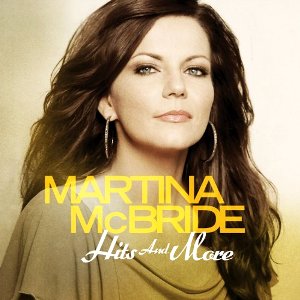
The smooth powerful voice of Martina McBride has been a welcome radio presence for two decades now. After eighteen years of hit singles, top-selling albums, and industry awards, November 2010 brought the news that McBride was exiting the RCA Nashville label roster. In the wake of her departure from her longtime label home, her hitmaking days on RCA are summarized on the career retrospective Hits and More, featuring seventeen of McBride’s best-known hits arranged chronologically, plus three new recordings. All of her RCA albums are represented except for her 1992 debut The Time Has Come (which produced no significant hits) and her 2005 covers album Timeless (which produced only one minor Top 20 hit with McBride’s rendition of Lynn Anderson’s “Rose Garden”).
It’s a generally acknowledged fact that McBride released her best and most significant material during her nineties career heyday, with her 2001 Greatest Hits package having covered this era thoroughly. On this new set, that era is condensed into the first nine tracks. Regrettably, this results in a few mighty fine songs – notably “Safe In the Arms of Love” and “Wrong Again” – getting squeezed out. It’s also worth noting that McBride has released several singles over the years that scarcely dented the charts, and thus have been repeatedly passed over in compilation albums, but that rank among her best work, and would make fine additions to any compilation album - See “Cheap Whiskey,” “Phones Are Ringin’ All Over Town,” “Cry On the Shoulder of the Road.”
Inevitably, the album starts to sag a bit once we get into the new millennium material, though for the most part, the collection doesn’t dwell on this era any more that necessary. “This One’s for the Girls” and “In My Daughter’s Eyes” both post-dated McBride’s original Greatest Hits collection, but have gone on to become top-tier McBride hits, and are rightly included on Hits and More. Several less-memorable singles, such as the lukewarm hits “How I Feel” and “I Just Call You Mine,” are omitted. The only “issue song” included is 2002′s “Concrete Angel,” and while glass-half-full anthems like “Anyway,” “Ride,” and “Wrong Baby Wrong” are enjoyable, they do lose some luster when they have to follow songs like “Independence Day” and “A Broken Wing.”
The three new tracks are largely superfluous, serving no real purpose other than buyer temptation. “Surrender” starts out fairly strong with a lyric about giving up a marital fight, but the chorus sounds like it doesn’t know what to do with itself, and the rest of the song just runs around in circles. “Straight to the Bone” benefits from a restrained vocal and a decent lyric, but suffers from a weak melody. “Being Myself” has a pleasant musical arrangement, but the title immediately tells you what kind of song you’re getting, and it’s not good enough to warrant inclusion at the expense of the far superior material that was left off.
Ultimately, however, Hits and More accomplishes its titular objective: to offer a summary of McBride’s biggest hits, along with a modest helping of new material – and of course to continue making money for RCA long after McBride has left the label. It falls a degree short of being a definitive collection, though to be fair, such would probably require two discs instead of one. It’s an adequate career introduction for the new Martina convert, even if her 2001 Greatest Hits album is still an overall better value. If you’re looking for a good place to start your Martina collection, you will likely find Hits and More to be a satisfactory purchase, but if you’re a longtime fan who already owns most of her material, you can safely pass on it.
Track listing: 1. My Baby Loves Me 2. Independence Day 3. Wild Angels 4. A Broken Wing 5. Valentine (with Jim Brickman) 6. Happy Girl 7. Whatever You Say 8. I Love You 9. Love’s the Only House 10. Blessed 11. Where Would You Be 12. Concrete Angel 13. This One’s for the Girls 14. In My Daughter’s Eyes 15. Anyway 16. Ride 17. Wrong Baby Wrong Baby Wrong 18. Surrender 19. Straight to the Bone 20. Being Myself
The song is about how we use vacations and spirits and such to escape the mundane lives we’ve settled into.
It’s a strong concept. But the fairly flat delivery and a production that never takes off keeps things a little too grounded in reality for it to actually sound like the escapism it celebrates.
Whenever we get new music from Alison Krauss & Union Station, there are two things we can generally count on: stellar musicianship, and pure, naturally beautiful vocals. Still, one variable is whether or not the music builds on the group’s tried-and-true musical formula of modern-bluegrass-meets-adult-pop, and moves it forward such that the approach does come across as merely business-as-usual. Last year’s set Paper Airplane contained the usual goods, but suffered to some extent from what one might call the plodding midsection syndrome – a cluster of competent but not particularly memorable tracks bookended by moments of brilliance.

In the context of the album, new single “My Love Follows You Where You Go” comes at a point at which things are just beginning to lose a little shine. It begins on a pedestrian-sounding note with a repetitive melody, and a first verse composed of a string of vague metaphors. But then the chorus comes, and the song gradually hits its stride. The melody rises, and the lyrics take on added specificity. At this point, we learn that the narrator’s lover is leaving her. The chorus rings quietly poignant by isolating the climactic moment in which her signficant other faces the outside world, preparing to depart. Though not attempting to deter him, Krauss’s character expresses grave awareness that her lover will one day “wake up, and the world is cruel and cold,” while simultaneously reaffirming her undying love – both in the titular phrase, and in the resolve of “I won’t pretend that it’s not killing me watching you walk away slow.”
The fourth verse is superfluous, not adding to or detracting from the story in any significant way. As a whole, the song doesn’t necessarily advance the group’s art, but it is an enjoyable variation on a reliable formula. Though the lyric could benefit from added straightforwardness, we are nevertheless left with a very good single, if not a great one.
While I would prefer that contemporary country artists stop looking to the pop-rock music of the mid-1980s for their primary influences, I can at least credit Eli Young Band’s relative good taste.
Other A-list groups may aspire to the MOR sounds of Air Supply and REO Speedwagon, but Eli Young Band’s “Even if It Breaks Your Heart” tips its hand to the Replacements and Paul Westerberg.
Which is to say that at least they’re trying to sound like a very good band instead of an awful one, so they’ve handily cleared a bar that their peers have set just a few scant inches off the ground.
As a cover of singer-songwriter Will Hoge’s single from a couple of years back, “Even if It Breaks Your Heart” is to-the-note faithful to the original arrangement and to its homage to all of the things the Replacements did well: The electric guitar power-chords are heavy and carry just a hint of distortion, giving the track a sturdy rock wash that can’t entirely mask how much the melody and construction owe to classic pop conventions.
What that has to do with classic country conventions is another matter entirely, but, considering how few singles on country radio at the moment have a memorable melody or show any real regard for how to structure a hook, “Even if It Breaks Your Heart” does get a few important things right.
Lead singer Mike Eli, for his part, sings the song with as much conviction as he can muster. The natural rasp in Hoge’s voice brought a greater sense of gravity to his performance than Eli can pull off, but he makes a game effort to sell the song’s familiar narrative. As yet another testament to dues-paying and big dreams, “Even if It Breaks Your Heart” is fine enough, but “Chasin’ That Neon Rainbow,” it ain’t.
So it’s a matter of good but not great song, given a credible performance by a competent band with the wherewithal not to want to sound like Journey. While that, regrettably enough, might actually make for one of the year’s standout country singles, “Even if It Breaks Your Heart” is undermined by its frankly terrible engineering.
Eli Young Band were on the losing side of the Loudness War in the recording of their track: Precious few guitar chords in the full duration of the performance actually ring to the full breadth of their tone, giving the single a clipped, tinny sound. Just as there’s no excusing the poor taste of so many of today’s country artists, there’s no excuse, given the available technology, for a single to sound as bad as this.
Written by Will Hoge and Eric Paslay.
Grade: Solid B for the song and performance, but a D for the recording…
“You’re Something Special to Me” is so laid back that it’s easy to miss the craftsmanship. As Strait channels a young Merle Haggard, a slow western swing arrangement surrounds him with warmth.
When people say he’s country music’s Sinatra, this is what they’re talking about.
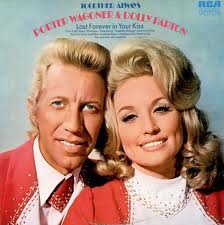
This is one of their most beautiful duets, largely because Parton is at her peak as a singer and a songwriter.
She gets Wagoner to up his game in return, and he sounds fantastic singing the first verse. But as was becoming the norm even outside of their duets, she simply outclasses him, taking the melody to new heights as she perfects her signature sound.
After having first formed in 2003, The Little Willies released their self-titled debut album in 2006, four years after pianist and vocalist Norah Jones had found success with her jazz and pop flavored solo album Come Away With Me.
Six years later, a second Little Willies album finally comes to light, following in the tradition of the first by featuring covers of country classics. For the Good Times finds The Little Willies covering classics songs by some of country music’s most revered (and most covered) artists, including nods to Willie Nelson, Johnny Cash, Hank Williams, Lefty Frizzell, Loretta Lynn, and Dolly Parton, among others.
The heart and soul of the project, however, is The Little Willies themselves. Much like the band’s previous effort, For the Good Times is unmistakably a group effort. Norah Jones and Richard Julien share lead vocal duties, while generous instrumental breaks give all five members – rounded out by Jim Campilongo on guitar, Lee Alexander on bass, and Dan Rieser on drums – ample room to shine.
If there is a noteworthy complaint to be leveled against the album, it is that its approach to selecting cover material is mostly by the book, in that it often leans on predictable choices that have been covered endlessly. In particular, Parton’s “Jolene” is one of the most covered songs by an artist whose catalog is ripe with hidden treasures waiting to be discovered, which is not to say that Jones does not sing it beautifully. Fortunately, the Willies have a strong knack for re-interpreting cover material in a way that feels respectful and reverent, but not overly so, and not to the point of becoming half-hearted re-creations of the originals. Thanks to creative, organic arrangements, they repeatedly clear the lofty bar of taking a well-known song, and making it seem new again.
One of the album’s best tracks is the surprisingly good cover of Loretta Lynn’s “Fist City.” Fact: Loretta Lynn is a hard one to cover. Her distinct persona and vocal style are so familiar that many artists have fallen into the trap of misguided mimicry – Just ask Sheryl Crow. But as it turns out, Jones acquits herself nicely by giving a performance that is true to her own vocal style, but that still conveys the sharp sass that the tell-it-like-it-is lyric calls for – She has never sounded feistier. Likewise, the band reworks the song into a two-stepping arrangement that serves it well, while still retaining its signature instrumental hook.
Elsewhere, there’s hardly a dull spot to be found on the record. Jones’ spirited performance of Lefty Frizzell’s “If You’ve Got the Money, I’ve Got the Time” is unshakably joyful, as is Julien’s take on Cash’s “Wide Open Road.” On a much different note, Jones’ and Julien’s half-singing, half-whispering performance of “Foul Owl On the Prowl” makes for a deliciously haunting mood-breaker. A slowed-down rendering of Hank Williams’ “Lovesick Blues,” as well as a hushed performance of the Kristofferson-penned Ray Price hit that serves as the title track, demonstrate the band’s wise focus on putting the songs themselves above all else. No matter which creative direction the band goes in with the songs they cover, their treatments never come across as gaudy or misguided, nor do they place the singer ahead of the song, but they consistently retain the emotional aspects of the originals.
The instrumental “Tommy Rockwood,” written by Campilongo, is a welcome addition, demonstrating that the The Little Willies are just as competent when cutting loose on an original song as when delivering a well-thought-out cover. Ultimately, it’s the band’s palpable, infectious enthusiasm for these tunes that makes the record tick. Despite some missed opportunities with regard to song selection, there is still no denying that what’s here is consistently well-executed, such that any lover of traditional country music will find Good Times to be a highly enjoyable listen.