Archive for October, 2011

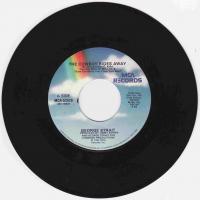
Retro Single Review: George Strait, “The Cowboy Rides Away”

Sunday, October 30th, 2011

1985 | Peak: #5

A classic single that embraces the traditional cowboy mythos while simultaneously reinventing it.

The title invokes memories of the cowboy archetype.  A relationship is coming to an end, so the cowboy saddles up and rides out of town, into the sunset.

Big difference here? He’s not leaving by his choice.  It’s the lady who holds the power here, and it’s the cowboy who’s on the receiving end of a broken heart.  This isn’t Waylon and Willie’s cowboy.

Written by Casey Kelly and Sonny Throckmorton

Grade: A

Next: The Fireman

Previous: Does Fort Worth Ever Cross Your Mind


Retro Single Review: Shania Twain, “God Bless the Child”

Sunday, October 30th, 2011

1996 | #48

Gospel recordings were becoming all the rage in the nineties, particularly with female artists.

Sometimes it seemed like they just wanted a big showpiece for the CMA awards.  Dolly Parton and Pam Tillis had performed with enormous choirs behind them in 1991 and 1994, respectively.  These were, perhaps, the only times in CMA history that the demographics on stage accurately reflected greater metropolitan Nashville.

In 1996, Shania Twain debuted a revamped version of “God Bless the Child” on the show.  Originally a short a cappella number that closed her breakthrough album, Twain added several verses that touched on a wide range of social problems that impact children.

Twain’s less than powerhouse vocals work in the performance’s favor.   Her restraint keeps the song from becoming overblown.  And in turn, what could have been mawkish remains reasonably thought-provoking and pleasant to the ears.

Written by Robert John “Mutt” Lange and Shania Twain

Grade: B+

Next: Love Gets Me Every Time

Previous: Home Ain’t Where His Heart Is (Anymore)

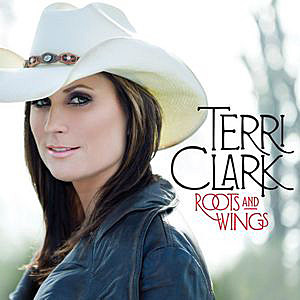
Single Review: Terri Clark, “The One”

Friday, October 28th, 2011

Terri Clark’s new release “The One” retains many of the familiar features that have made Clark’s music so enjoyable.  It has a pleasant restrained production arrangement, and a nuanced, sincere vocal performance, along with an interesting lyrical scenario with some clever turns of phrase.

What it’s missing is a good hook.  The unoriginal hook of “I don’t need a love I can live with/ I want the one I can’t live without” bears a strong resemblance to songs like Clint Black’s “The One She Can’t Live Without,” and that feels like a notable artistic liability, mirrored by the song’s ho-hum two-syllable title.  As mentioned before, there’s still some musical goodness to be heard on this track, but the lack of a great hook leaves a bit of a hole in the song, so to speak.  Thus, a potentially interesting song ends up feeling somewhat vanilla.

It still sounds pretty good, but like the first two singles released from the album, it’s just not great.  As a whole, Roots and Wings is a better album than the three singles would lead one to think.  How long until the great songs get released instead of just the “pretty good”?

Written by Tom Shapiro and Jim Collins

Grade:  B-

Listen:  The One

Album Review: Scotty McCreery, Clear as Day

Tuesday, October 25th, 2011


Scotty McCreery

Clear as Day

In listening to American Idol winner Scotty McCreery’s debut album, it becomes all too clear that either McCreery is being carefully reared by the unabashedly commercial-minded execs of 19 Entertainment… or that he simply enjoys playing follow-the-leader.  The former is most likely, but almost every track on Clear as Day sounds like an emulation of the style of one of country radio’s favorite hitmakers.  We get to hear Scotty McCreery play Montgomery Gentry.  We get to hear Scotty McCreery play Kenny Chesney.  But there are precious few moments in which it sounds like Scotty McCreery is being Scotty McCreery.

“Water Tower Town” sounds like something lifted out of the Montgomery Gentry reject pile circa 2002.  “Better Than That” carries a strong thematic resemblance to Kenny Chesney’s “Never Wanted Nothing More,” with nothing about it’s story structure feeling at all urgent or revelatory.  On another note, it comes as no surprise that “Walk In the Country” was co-written by Urban, as the track clearly has Urban written all over it. (Think “Where the Blacktop Ends”)  Such style-mimicking demonstrates the fact that, as a whole, Clear as Day falls into the common trap in which commercialism overshadows an album’s artistic merits.

Somewhat oddly, it’s the two singles released thus far that represent the album at its absolute worst.  “I Love You This Big” scans as a grammatically-awkward piece of schmaltz with an uninspired production and a dull, auto-tuned vocal.  “The Trouble with Girls” merely sounds like a cute little basket of cliches, as if the writers were more concerned with struggling to find words that rhyme than connecting with a listener on more than a surface level.  At the same time, the dramatic orchestral swells in the bridge make the song sound like it’s taking itself way too seriously.  It’s all too obvious that the songs’ sole purpose of existence is to serve as inoffensive distractions between radio commercials.  They are so carefully calculated so as to make no negative impression that they end up making hardly any impression at all.

In most cases, lyrics rarely scratch below surface level.  High school hallways serve as a common stage setting – Little surprise, given McCreery’s age of 18 – with many of the tracks playing like gender-flipped versions of Taylor Swift songs, minus the authenticity and distinct perspective.  The title tracks recalls a few mundane details of an encounter with a romantic flame, only to settle for a clumsy grasp at the heart strings by killing the girl off in the end.  The songs that work are those that emphasize the melodies and Scotty’s performances above the generally mediocre lyrical content.  “Write My Number On My Hand” finds McCreery turning in what is possibly his most engaged performance of the set, with a wink-wink country boy charm that effectively sells the silly lyrics.  But that’s not to say that all of the songs are lyrical duds.  With “Dirty Dishes,” McCreery taps into the universally acceptable country radio theme of faith, and offers a take that is actually interesting.  The song (written by Neil Thrasher, Michael Delaney, and Tony Martin) portrays the narrator’s mother saying “the strangest prayer ever said,” in which she thanks God for dirty dishes, noisy children, slamming doors, et cetera, and then highlighting the positive aspects of common domestic annoyances.  Less effectively, however, “That Old King James” scans as an inferior “Three Wooden Crosses”-wannabe.  It tracks the life journey of a King James Bible as it is passed down through different family members, but it lacks a clear message to serve as a form of listener payoff.

At its best, Clear as Day continues to offer glimpses of the substantial well of talent McCreery possesses.  But at the same time, that talent sounds like it’s a long way from being fully realized.  He’s not Josh Turner.  He’s not George Strait.  He’s not John Michael Montgomery.  But when it comes to portraying who Scotty McCreery is as an artist, Clear paints a picture that is disappointingly murky.

Retro Single Review: Alan Jackson, “Love’s Got a Hold On You”

Tuesday, October 25th, 2011

1992 | #1

Man calls doctor.  His ailment?

“My hands are sweaty and my knees are weak/ I can’t eat, and I can’t sleep/ It’s turning me every way but loose…”

Diagnosis:  “Sounds like love’s got a hold on you.”

Alan Jackson’s fifth number-one single is, for the most part, pure novelty.  It’s the kind of campy little tune that could either go very right or horribly wrong.  Fortunately, Jackson’s recording never sounds like it’s taking itself too seriously.  The light jaunty arrangement creates just the right mood for the silly lyrics, while Jackson’s laid-back delivery fits the song like a glove.  The result is that Jackson creates an infectious singalong-friendly earworm out of a song that could have been a grating annoyance in the wrong hands.

It might not be one of Jackson’s most essential efforts, but “Love’s Got a Hold On You” makes for a fun and enjoyable detour in his storied hit catalog.

Written by Carson Chamberlain and Keith Stegall

Grade:  B+

Listen:  Love’s Got a Hold On You

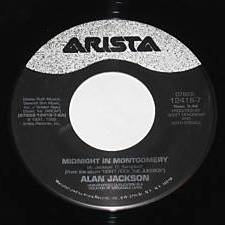
Retro Single Review: Alan Jackson, “Midnight in Montgomery”
Sunday, October 23rd, 2011

If you’re looking for a genuinely spooky song for the Halloween season, look no further than Alan Jackson’s chilling “Midnight in Montgomery.”

From the very first strains of the downbeat acoustic guitar followed by the eerie steel intro, it’s evident that this is no typical country love song or drinking ditty. Instead, it’s set at Hank Williams’ grave at midnight whereupon the narrator, presumably Alan Jackson, sees Hank’s ghost.

The song’s story is fascinating in and of itself, but equally impressive is the recording as a whole package. Along with the ominous production and chilling story, Jackson’s performance strays from its usual smooth reliability and picks up its own haunting quality, which perfectly adds to the overall darkness of the song.

What’s more, much like a Hitchcock thriller, the parts of the song that capture this compositional masterpiece is not violence and blood, but rather, masterful storytelling that is thanks to the lyrics, production and performance that forms a psychologically thrilling listening experience rarely captured in country music.

Written by Alan Jackson and Don Sampson

Grade: A

100 Greatest Men: #77. John Conlee

Sunday, October 23rd, 2011

100 Greatest Men: The Complete List

One of the greatest vocalists of his generation, John Conlee powered to stardom on the strength of a self-written hit that would provide both his musical and fashion signature for the rest of his career.

He’d been singing and playing guitar since early childhood, but his first career was as a mortician, followed by a stint as a radio deejay.    He moved to Nashville in 1971, and five years later, he earned his first recording contract with ABC Records.
A handful of singles failed to gain steam, including “Backside of Thirty”, which would later be re-released when “Rose Colored Glasses” took off.  That breakthrough hit made it to #5, its chart placing limited by its slow ascent, as early stations dropped the record while latecomers were still adding it.

ABC soon folded into MCA Records.  Through 1985, Conlee had his biggest string of success with that label, connecting with signature hits like “Common Man” and “Friday Night Blues.”  His dark sense of humor surfaced often, with eerie hits like “She Can’t Say That Anymore” and “I Don’t Remember Loving You.”

After seven years and two greatest hits collections, Conlee moved to Columbia, where he kicked things off with four consecutive top ten hits.   Radio success cooled when he moved to independent labels in the late eighties, and he made his last chart appearance in 1990 with the comedic single, “Doghouse.”

Conlee’s distinctive vocals earned him award nominations early in his career, and he is recognized as one of the strongest talents from the Urban Cowboy era, managing to bring a traditionalist edge to even his most pop-flavored productions.  Conlee can still be widely heard on the Grand Ole Opry and the concert circuit.  He released a well-received gospel collection in 2006, but his faith has been expressed long before that through action.  His various charitable endeavors include work on behalf of children’s hospitals and family farmers.

Essential Singles:

  • Rose Colored Glasses, 1978
  • Backside of Thirty, 1979
  • Friday Night Blues, 1980
  • Miss Emily’s Picture, 1981
  • Common Man, 1983
  • As Long As I’m Rockin’ With You, 1985

Essential Albums:

  • Rose Colored Glasses, 1978
  • Friday Night Blues, 1980
  • With Love, 1981
  • Busted, 1982
  • Blue Highway, 1984

Next: ?

Previous: #78. Brad Paisley

100 Greatest Men: The Complete List

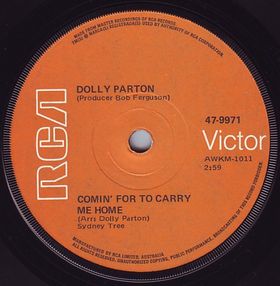
Retro Single Review: Dolly Parton, “Comin’ For to Carry Me Home”

Sunday, October 23rd, 2011

1971 | Peak: #23

RCA’s bizarre mangling of Dolly Parton’s catalog kept this single from wide availability until the 2009 release of the box set Dolly.

Even more bizarre? It wasn’t included on her gospel album, The Golden Streets of Glory, which was released the same year as this single.

It’s a shame because it’s a raucous and genuinely uplifting arrangement of a gospel standard, and it pushes Parton further as a singer than anything had up until that point.

Traditional.  Arranged by Dolly Parton.

Grade: A


100 Greatest Men: #78. Brad Paisley

Tuesday, October 18th, 2011

100 Greatest Men: The Complete List

A musician since receiving his first guitar at age eight, Brad Paisley emerged in the late nineties and became the most consistently successful radio artist in the decade that followed.

Paisley’s career began in earnest when he penned his first song at age twelve, “Born On Christmas Day.”  His junior high principal invited him to perform at a local function. He was spotted by a representative of Jamboree USA, and after one performance, he was invited to join the cast.
Over the next eight years, Paisley performed in West Virginia, opening up for major country acts when they visited the area.  After completing a two year stint at Belmont University in Nashville, he was immediately signed to a publishing deal with EMI.   After penning hits for David Kersh and David Ball, he signed with Arista Records.

His debut album, Who Needs Pictures, featured two top #1 hits.  The first one, “He Didn’t Have to Be”, began a string of award show nominations that continues through this day.   As the 2000s progressed, he reaped awards for his collaborations with Alison Krauss, Keith Urban, Dolly Parton, Little Jimmy Dickens, and George Jones.

Paisley was the first male artist since Earl Thomas Conley to score ten consecutive #1 hits on the Billboard charts.  His innovative videos incorporated appearances from Hollywood television stars, often satirizing their own public images to humorous effect.  At the peak of his popularity, Paisley showcased his Grammy-winning instrumental skills. With Play, he became the first mainstream country artist since Steve Wariner to release a largely instrumental album.

Now a touring powerhouse, Paisley collected his first Entertainer trophy from the CMA in 2010, joining shelves full of awards for Male Vocalist, Single, Album, Music Video, and Musical Event from all three major industry organizations.  Most recently, he has scored #1 hits collaborating with Alabama and then Carrie Underwood. The latter collaboration, “Remind Me”, became his fourth platinum-selling digital single, following “Whiskey Lullaby”, “She’s Everything”,  and “Then.”

Essential Singles:

  • He Didn’t Have to Be, 1999
  • I’m Gonna Miss Her (The Fishin’ Song), 2002
  • Whiskey Lullaby (with Alison Krauss), 2004
  • When I Get Where I’m Going (with Dolly Parton), 2005
  • Letter to Me, 2007
  • Waitin’ On a Woman, 2008

Essential Albums:

  • Mud On the Tires, 2003
  • Time Well Wasted, 2005
  • 5th Gear, 2007
  • American Saturday Night, 2009

Next: ?

Previous: #79. Hank Locklin

100 Greatest Men: The Complete List

Retro Single Review: Porter Wagoner & Dolly Parton, “Better Move It On Home”

Monday, October 17th, 2011

1971 | Peak: #7

A few too many elements in the mix here.

The arrangement is like “Joshua” with a horn section.  It overwhelms the humorous dialogue.

It doesn’t help that they don’t sound like they’re in on the joke.  They go for deadpan but fall short, and end up sounding a bit too serious in the end.

Written by Ray Griff

Grade: C


Writers

Latest Comments

Most Popular

Worth Reading

View Older Posts